Managing Diabetes this Festive Season

0

The period of feasting and fasting can have an impact on your blood glucose levels

Festivals hold a deep significance in Indian culture and no celebration is complete without sweets and delicious food. Through the year, we have festivals form the harvest season, the triumph of good over evil, festival of lights, colors, you name it. And for every festival there will be a variety of food, especially fried food. Some festivals involve fasting as well only to end with a big feast. We love to celebrate. However, suffering from diabetes could be a hindrance to your celebration.

The period of feasting and fasting can have an impact on your blood glucose levels. Generally, fasting is quite a challenge for most people but it appears to be more of a problem for those with diabetes. If diabetes is to be well controlled, it is essential to eat in a timely manner. However, during fasting for religious reasons, there can be an increase in glucose production in the body and a reduction in insulin levels. This can totally upset the control of diabetes.

Here are some guidelines for seniors to enjoy the festival to the fullest:

Do not skip medication – To enjoy the celebrations you must never forget to have your medication on time. Continue self-monitoring the glucose level and do some light exercises or go for a morning walk.

Fasting – Fasting is not meant for everybody however if you are fasting, avoid starving yourself. When you are fasting hydration is a must. Include a lot of fruits and vegetables in your diet and increase the fiber content of your food using bran.

Feasting – It would be unrealistic to not indulge in festive food. Hence instead of eating three large meals a day, break up your meals into smaller portions of about four to five times a day. This can keep your blood sugar levels more stable. If you are hungry have a handful of nuts instead of sweets.

Share your calories – If you have a box of sweets for yourself avoid gorging on them instead share it with your loved once and have a small bite to satiate your sweet cravings. You can opt for a good quality dark chocolate as it has lower sugar quantity.

Refrain from alcohol – Alcohol contains a large quantity of sugar in it and can increase blood sugar levels dramatically. Hence it would be best for you to avoid alcohol during festivals.

Instead of fried opt for baked/grilled – Instead of snacking on deep-fried samosas and pakoras opt for baked samosas and pakoras.

High Fibre Food – If you are consuming high-calorie foods include high fibre food along as it will help relieve constipation. Avoid eating red meat instead you can have fish.

Pick a smaller plate – A bigger plate will make you consume more and a smaller plate will give you a sense of fullness when you look at your plate.

Finally eat until you are satisfied, not until you are full.

No Full Stops @ 90

7

The nightingale gets set for some more recording sessions as she turns 90 today (September 28)

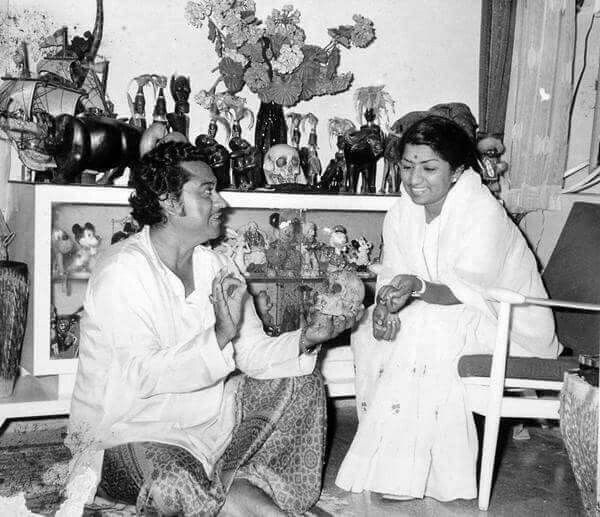
Fondly addressed as Didi, Bharat Ratna Lata Mangeshkar isn’t going to rest easy as she celebrates her birthday today.

Born into a family of artistes on 28 September 1929,  Mangeshkar began acting in Marathi musical plays at her father, Deenath Mangeshkar Theatre Company.

Didi’s original name was Hema and was renamed Lata based on a character ‘Latika’ from her father’s play Bhaaw Bandhan. At the age of 13, after the demise of her father in 1942 young Lata shouldered the financial responsibilities of her family. Lataji moved to Mumbai in 1945.

Lataji had a rocky start as her voice was considered too thin and sharp. Hence she would often imitate Noor Jahan to satisfy music directors. She was then mentored by music director Ghulam Haider and under his guidance, she got her first recognition in 1948. The song ‘Ayega Anewala’ from the film Mahal in 1949 became a hit and her career took off from there. She began to work with all major music directors and playback singers of the time. In 1958 she won her first Filmfare Award as a playback singer for ‘Aaja Re Pardeshi’ from the film Madhumati.

We had the privilege to interview her in our first issue where she has shared about her life, work, passion and her relations with the contemporaries where we were introduced to a different side of Lata Didi. To read more  Click Here

To Wish Lata Didi on her birthday, leave a comment below. 

(Image Source – Pinterest )

How Navratri is a Perfect Blend of Scientific and Religious rituals?

0

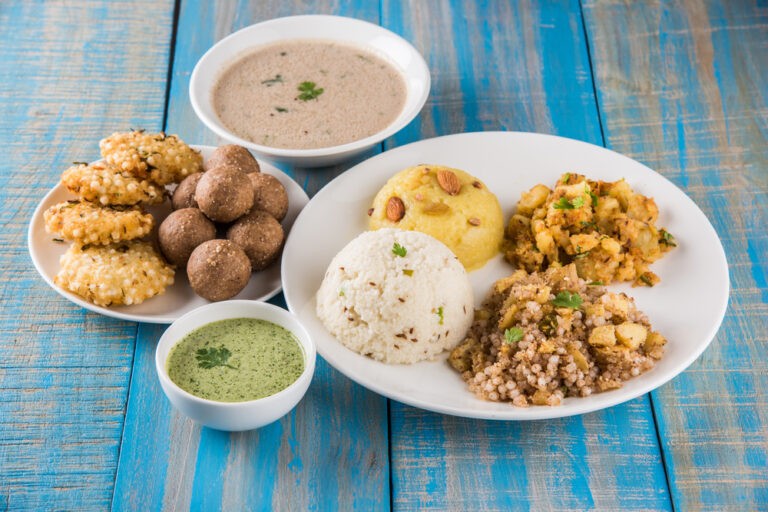
Nine days of ultimate detox with Sattvik diet

With Navratri around the corner people throughout the country get into the groove of celebrating the nine scared days. Nava (nine) ratri (night) marks the arrival of a new season. It occurs four times in a year marking the arrival of each season out of which the most celebrated one is Sharada Navratri which means autumn and it takes place typically after or during autumn harvest (September-October).

According to the religious rituals fasting during Navratri evokes the power of Shakti (divine energy) in your body. But from a scientific point of view our bodies become more vulnerable to diseases as the seasons change and a good diet is essential to boost our immune system. Hence the ancient Indians ushered in the new seasons with sattvik diet to allow your body to get used to the change.

Sattvik diet is considered extremely healthy. It gives you an opportunity to take a break from high calorie, high fat delicacies that can shoot up your glucose level. It constitutes of ingredients recommended by modern dieticians and nutritionists. Most ingredients are gluten free, packed with fiber, antioxidants and is diabetic friendly.

Here are the sattvik ingredients you can consume during Navratri:

  • Quinoa
  • Buckwheat (kuttu)
  • Barnyard millet (sama rice)
  • Water chestnut (singhara)
  • Amaranth seeds (rajgira)
  • Potatoes
  • Pumpkin
  • Sweet potato
  • Bottle gourd
  • Cumin
  • Black pepper
  • Rock salt
  • Pink salt
  • Green cardamom
  • Ginger
  • Cucumber
  • Green chillies
  • Lemon
  • Mint leaves
  • Curry leaves
  • Milk and milk products (paneer, curd, ghee, khoya)
  • Brown sugar
  • Honey
  • Jaggery
  • Coconut
  • Groundnut oil
  • Dry fruits
  • All fruits
  • Sago seeds (sabudana)
  • Makhana

Navratri-friendly dishes that will help boost your immunity:

  1. Quinoa – One of the popular health food around the world. It is high in protein and has sufficient amount of essential amino acids although it is high in carbohydrates. It improves overall health, metabolism, blood sugar and cholesterol levels.

Navratri friendly dishes:

  • Quinoa with coconut stew
  • Quinoa poha
  • Quinoa porridge with pumpkin and spinach
  1. Buckwheat Flour (Kuttu ka atta) – It is gluten-free, has a good source of fiber, contains high quality protein and rich in minerals. It is good for your colon, improves blood sugar and promotes healthy heart.

Navratri-friendly dishes:

  • Kuttu paratha with cucumber mint raita
  • Kuttu upma
  • Kuttu crepe with apple filling
  • Kuttu dosa with coriander chutney
  • Kuttu pancakes with honey
  1. Water chestnut (Singhara) – It is a delicious aquatic tuber vegetables found around September-October. They are very nutritious and low in calorie, has high amount of antioxidants. It is very versatile and can be consumed raw, boiled, grilled and candied.

Navratri friendly dishes:

  • Singhara halwa (you may use jaggery instead of sugar)
  • Singhara paratha with lauki (bottle gourd) kheer
  • Singhara tikki with curd or coriander chutney
  1. Amaranth seeds (Rajgira) – It is a good source of calcium, protein and amino acids. High in iron, minerals and it is the only grain which contains vitamin C. It reduces the risk of osteoporosis.

Navratri-friendly dishes:

  • Rajgira porridge with milk
  • Rajgira paratha with masala dahi
  • Rajgira ki kheer
  • Rajgira cookies
  • Rajgira pudding
  • Rajgira leaves stir fried
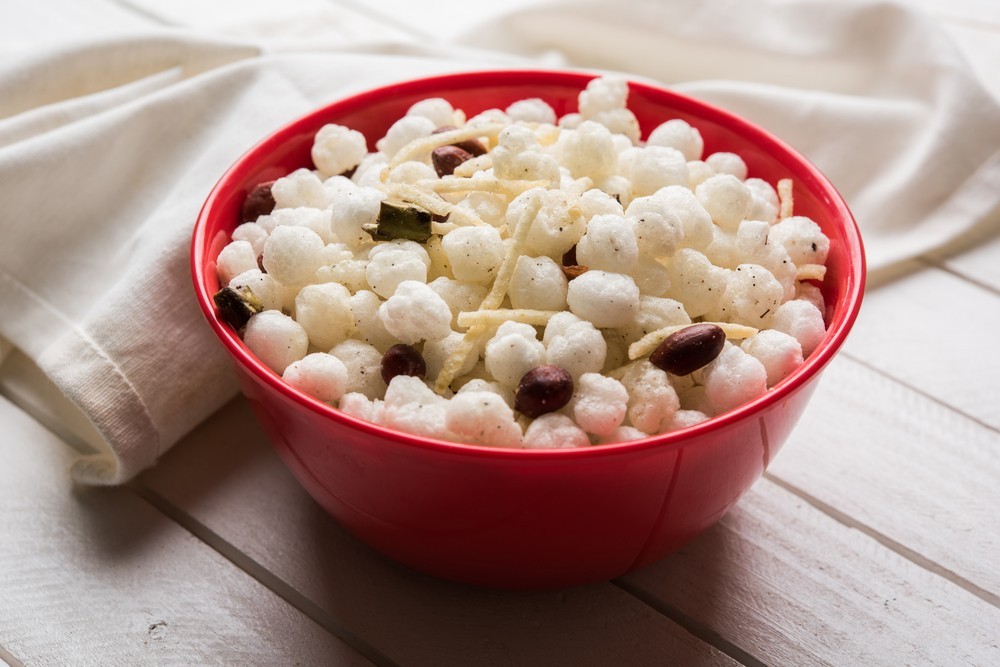
  1. Fox nuts (Makhana) – They are low in calories, fat and sodium. It has high calcium content which is good for teeth and bones. It also has astringent properties which is good for kidney ailment. It is rich in fiber and aids in constipation problems and helps get rid of insomnia. Makhana is a super snack that is healthy which makes you feel full so further cravings of binge eating is reduced.

Navratri-friendly dishes:

  • Makhana kheer
  • Roasted makhana with black pepper and sea salt
  • Makhana aloo tikki with coriander
  1. Barnyard millet (Sama rice) – A popular substitute for rice during fasting. Barnyard millet is low in calories, rich in fiber, rich in iron, low in carbohydrate content, high level of calcium content and a good source of protein. It controls blood sugar level and improves digestion.

Navratri-friendly dishes:

  • Sama pulao with cucumber raita
  • Sama rice dhokla with coconut chutney
  • Sama rice ki tikki with coriander chutney
  • Sama curd rice

Additional important things to keep in mind are – eat in moderation throughout the day do not starve yourself. Keep yourself hydrated; sipping on fluids throughout the day will prevent dehydration.

Side-effects of a bigger belly at sixty

2

Larger waist size could accelerate your brain’s age by at least a decade


The aging of the brain becomes inevitable as we age. However, there is always a way to maintain the sharpness and the agility that was once there. The cortex of the brain is responsible for cognitive skills from simple to complex. It is the thin outermost layer of the nerve cell tissue in the brain, measuring a few millimeters in thickness.


One of the factors that have an impact on your brain is your waistline. A bigger waistline in your sixties has an adverse effect on the brain by slowing it down.


Body Mass Index (BMI) is the weight of an individual in kilograms divided by the square of height in meters to measures the size of a body. According to the World Health Organization, a BMI of 30 kg/m2 is associated with obesity, 25-30 kg/m2 considered as overweight, and 18.5-25 kg/m2 as normal.


A study conducted by Dr. Tatjana Rudnek, a professor of neurology from the University of Miami, involved 1289 participants aged 64 years having ten years of education. Of which 60% were women, and 40% were men out of which 66% were Caribbean Hispanic. The study began with measuring their BMI and waist circumference to measure the thickness of the cortex area of the brain, its volume, and other factors through MRI scans. Six years later, participants went through MRI scans again, and the results were significantly associated with the thinner cortex. Of 1289 participants, 346 had a BMI of less than 25, which is considered normal. 571 had a BMI of 25 to 30 and was associated with 0.098mm thinner cortex. The remaining 372 had BMI over 30 were associated with 0.207mm thinner cortex.


Dr Rundek said, “In normal ageing adults, the overall thinning rate of the cortical mantle is between 0.01 and 0.10mm per decade, and our results would indicate that being overweight or obese may accelerate ageing in the brain by at least a decade.”


A thinner cortex also adds to the risk of developing dementia and Alzheimer’s disease.


A higher BMI is linked to having a thinner cortex, even after adjusting factors such as high blood pressure, alcohol use, and smoking.


On the brighter side, a healthy lifestyle can prevent the brain from ageing and overall BMI.

How to deal with emotional upheavals?

1

Don’t let negative emotions take over your life and health

Our emotions have an immense effect on our daily lives. The way we react to various situations sometimes leaves us with regrets. Hence it is important to look out for signs if your mood keeps changing depending on circumstances. You need to practice your minds to not get affected by different events and prevent it from becoming salves of your emotions.

Here are some possible solutions to keep your emotions in check

  • Identify – When something disturbing takes place, identify the kind of emotion that takes over you? Is it anger, worry, insecurity, anxiety, sadness or depression? Once you can find out what makes you emotional, it can be tackled.
  • Let go – Holding negative emotions and constantly thinking about it troubles your wellbeing. Instead of holding on to it you must learn to let go of them and try to relax. One fairly easy way is to maintain a diary where you can write about the feelings that are troubling you and get it out of your system – believe me it helps. It is worth learning meditation and pranayama as it will help you stay calm. Meanwhile, the easiest is trying to say your alphabet backwards Z Y X… It will make you concentrate and divert your mind from negative thoughts.
  • Forgive and Forget – Stop blaming yourself or anyone else for a given situation. Try to forgive and forget. The more you keep thinking about it, the more miserable you will be.
  • Pick up a hobby – Take time out to indulge in hobbies like painting, singing, cycling, gardening, playing games etc. A hobby will improve your mood and keep you mentally occupied leaving less time to sulk and fret. The idea is to divert your mind towards something that needs concentration and has a positive output.
  • Only good vibes – Detach from the negative feeling, situation, person or place and stop dwelling on it. Instead, go for a walk or a stroll it will help you clear your mind. If you are unable to go away physically, listening to your favorite music or watching a movie can be a tremendous diversion.
  • Catch up with friends – Ring up an old friend or friends and get together to relive old times. This is one of the most effective ways to improve your emotional health. It recharges you in many ways and keeps you feeling happy for a long time. Laughing together especially over silly childhood things is great.
  • Take a step back and breathe – Never react instantly because in all probability you will regret your actions or speech in retrospect. Think over it, take a few deep breaths, drink a glass of water or take a short walk and then respond to the situation..
  • Set short term achievable goals – Goal setting for things you want to achieve over a period also helps overcome disappointments. It will not only keep you occupied but also make you feel good about yourself. So instead of feeling helpless and dejected, use it to your advantage. Take a break, sleep well and start afresh with renewed energy.
  • Confide – In the worst of situations, reach out to a friend you can confide in and ask for help. You may feel embarrassed but don’t let that stop you from opening up as holding back will causes you more distress.

Managing Wrinkles the Natural Way

0

 The best way to avoid wrinkles from developing further is to protect your skin from sun – face, neck, forearms, and hands

Wrinkling of the skin is a natural ageing process. It happens due to lack of collagen – the vital protein that keeps our skin plump and smooth. Collagen begins to diminish slowly from our mid 20s and by the time we are in our 80s, our bodies have fourth of what we started out at birth. The best way to avoid wrinkles from developing further is to protect your skin from sun – face, neck, forearms and hands. However there are ways to improve the appearance of wrinkles.

  1. Aloe Vera gel – As skin begins to lose moisture it is essential to keep it hydrated as much as possible. Applying Aloe Vera gel will keep your skin hydrated and significantly reduces the appearance of wrinkles.
  2. Food with nutritional benefits – Informally known as ‘Superfoods’ or ‘wrinkle-busting foods’, are foods containing health benefitting nutrients and antioxidants proven to have positive effect on your skin. They appear to prevent wrinkles from developing and are also beneficial for overall health. You may include these key ingredients to your diet – avocados, chia seeds, oatmeal, tomatoes, ginger, walnuts, salmon, sardines, miso, egg whites and sweet potatoes.
  3. Vitamins A, C and E – Vitamins A, C and E are antioxidant that helps prevent wrinkles and promote a lovely, healthy glow. Eating food rich in vitamins will increase your body’s ability to produce the anti-wrinkle protein. It helps to create collagen in the skin.
  4. Essential Oils – Applying few drops of essential oil mixed with a carrier oil (coconut oil) on wrinkles help reduce them. Essential oil such as – argan, grapeseed, neroli, geranium, sandalwood, pomegranate and carrot seed. Before applying it directly on your wrinkles, do a patch test. Apply a small patch of the mixture (few drops of essential oil + coconut oil) on the inside of your wrist and wait for 24 hours. Avoid using if you experience any irritation, redness or stinging.
  5. Olive Oil – Consumption of olive oil will protect your skin from developing more wrinkles. Olive oil and its byproducts contain a compound that can increase the skin’s collagen level.
  6. Beauty Sleep – Sleep is essential for healthy skin and sleeping on silk pillowcases is a cherry on top. As silk pillowcases contain protein and enzymes which enhance the production of collagen and are hypoallergenic. Also, it is easy on the skin and can reduce fine lines.
  7. Facial yoga – A way to a natural facelift. Just like your body your face also requires exercise to stay toned and firm. Says Danielle Collins, the world-leading Face Yoga expert: “The 57 muscles in the face and neck need to be exercised. As they become stronger they are lifted and firmed and the skin attached to the muscles is tautened, reducing lines and wrinkles”. She recommends a routine followed by a glass of water to hydrate the skin and help flush the toxins.

Here are three exercises that you can try at home:

  • The ‘V’: to reduce lines and wrinkles around eyes

Put both middle fingers together between your eyebrows then apply pressure to the outer corners of eyes with index fingers. Look up and start to move the lower eyelids upwards. Relax and repeat six more times. To finish, squeeze eyes shut for 10 seconds then relax.

  • Smile Smoother: to reduce lines around mouth; to lift and firm cheeks and jaw

Hide your teeth with your lips and make an ”O’’ with your mouth. Then, smile as widely as you can and keep hiding your teeth. Repeat six times. Next, hold the smile shape and place one index finger on your chin. Then start to move your jaw up and down as you tilt your head back. Relax and repeat twice more.

  • Giraffe: to tone and lift the neck

Looking straight ahead, place finger tips on the top of neck and pull the skin down as you tilt head back. Bring head back down and repeat twice. Then jut lower lip out as far as possible, place fingers on collarbone and point chin upwards, pulling the corners of your mouth down. Hold for four deep breaths.

The Zoji-La Breakthrough

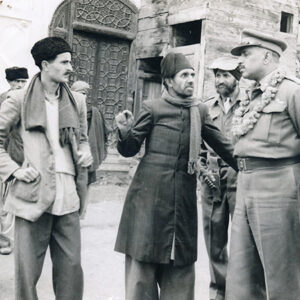
The month of September marks the movements that led to the Zoji-La Breakthrough and the Defence of Ladakh in 1948. The first war article by India’s first war correspondent, the late Sati Sahni, tells the story

JAMMU & KASHMIR (1947-48)

It is rarely given to individuals to be an eye-witness over a tumultuous period in the history of a region’s people. If the person has had the good fortune of being present or has participated in most of the events, he should not only take pride but at some stage or other, depending on circumstances, decide to share them with others. I had the rare opportunity and a privilege given to very few, to have been a witness to all the four major wars of independent India as an accredited war correspondent.

Reporting from the front is a specialized kind of job. Firstly you are to co-relate a particular incident or a battle in a correct perspective.  Then there are constraints of opportunity, the intensity of battle, difficult means of communication, time, space, etc. In this situation, most of the time one has to exercise his/her judgment in leaving out matters from reporting which over a period seem to have their own importance.
The background   

The indecision by Maharaja Hari Singh, ruler of the state of Jammu & Kashmir, on the issue of aligning with India was mainly due to the pending lapse of the British Paramountcy. The decision to partition India led to the collapse of this important administrative instrument. The division of forces was to be on the basis of the formula of 2/3 (India) : 1/3 (Pakistan). The Indian Independence Act 1947 had provided that a state could conclude a “standstill agreement” with either of the dominions of both. Accordingly, the Prime Minister of Jammu & Kashmir at that time, MC Mahajan, had telegraphed Karachi and New Delhi requesting for the continuance of existing arrangements under this agreement. The Pakistan government agreed telegraphically to the standstill agreement with J&K, but it had other plans. It must be remembered that the main road to the Kashmir valley was through now what is Pakistan. (Read What exactly happened in Kashmir in 1947 – The Kashmir Document)

Soon after Pakistan came into existence it formulated plans to force the Maharaja to accede to it by strangulating the supplies and communication and by other coercive methods. Whose wisdom allowed the important Posts and Telegraphs Department to be handed over to Pakistan to run is very circumspect as the diabolical plans were already made to get to this end. To achieve this they started the armed Kabali invasion in Uri and Baramulla and simultaneously subverted the Muslim population and the state forces.
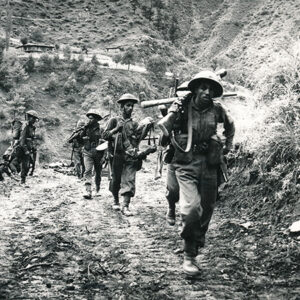
However, it was the economic blockade of the Valley which was the defining factor of this three-pronged war. There were forced food shortages, depletion, and rationing of petrol and other fuels. The postal department handling all cash transactions and banking activities were totally strangulated, thus making miserable the ordinary life of the Valley residents. The communal disturbances fuelled by Pakistan added to the travails of the state administration whose forces were distributed across the state in penny packets. Soon small numbers of people started migrations in different directions. The situation in the Poonch area became serious as the state’s ragtag force was fighting against well-armed fighters as well as the Pakistani army in uniform. This was part of the deliberate plan, as it was the pre-cursor to the large-scale invasion into the valley by “tribals”.

By around the middle of October, the state was largely incapacitated and there was no administration as such. The main attack plan was called “Operation Gulmarg” and was actually handled and signed by the head of the Pakistan Army. Each of the detachment of these tribals was commanded by a Pakistani army regular without uniform. The attacks started on 21–22 October with Muzzafarabad being the epicenter. The state forces unfortunately aligned themselves with the Kabali raiders and so this important city was over-run. Soon Domel – strategically important – was taken. There really was no resistance in between Domel and Uri. It was here that Brig Rajinder Singh, chief of the state forces, laid defenses to halt the massive invasion. Unfortunately, his motley forces could not hold the position as they were outnumbered. After retreating a number of times, the state forces were totally destroyed and the gallant Brig Rajinder Singh too fell on the outskirts of Baramulla. This town was completely destroyed, looted and raped. Many years later my good friend, Melville De Mellow, made a radio feature and called it “The Rape of Baramulla”. That radio feature brought tears to the eyes of PM Nehru and the many others who heard about the depravity of the marauders.
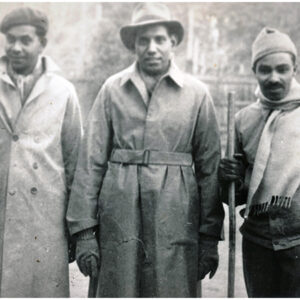
These events, as well as the overall situation being desperate, prompted the Maharaja to request the Indian Government for assistance and help. From Baramulla, the raiders had advanced to a small hamlet, Shalteng, just 5 kms out of Batmaloo, Srinagar. It was decided by the cabinet in Delhi that the Indian forces could only be sent after a written document was signed by the state ruler. It was at this juncture that the Maharaja signed the Instrument of Accession on October 26, 1947, thus paving the way for the Indian forces to begin operations. The famous battle of Shalteng on the outskirts of Srinagar is considered to be one of the defining factors in the history of Kashmir. It was by the end of December ’47 that the Indian forces were able to push back the raiders beyond Uri. There is controversy as to what led to the Indian army to withhold operations as they had the invaders running. Had the offensive continued there was little doubt that the Indian Army could have taken back Domel and Muzzaffarabad. and further even Mirpur. This mystery was neither unravelled nor debated in an open forum, ever. It is well known that PM Nehru diverted efforts to the Poonch area with instructions to hold onto that area at any cost.

The winters of 1947–48 were significant, as the defences of the Valley was bolstered and now they were a lot more prepared. In fact in May 1948 an offensive was launched to capture Domel; unfortunately, the Pakistanis were also shoring up their defences and this resulted in pitched battles but little else. Except for some minor gains, there was a stalemate. The Indian forces were numerically smaller than the determined Pakistanis with a much larger force. This emboldened the Pakistanis to choose and select some strategic targets and the result was that India ceded large swathes of territory in the Jammu area as well as the areas west of Uri. Unfortunately, the Pakistanis shifted focus to the North comprising of Gilgit, Kargil, Skardu and Ladakh.

The strategic areas of Gilgit, Skardu and Kargil were now targeted by the Pakistanis, who decided that it would put pressure on the Indian forces by opening up the Northern front apart from the already active Western front (Uri & Poonch). With the termination of the Gilgit lease in July 1947 the area which was back with the Jammu & Kashmir state forces was hardly in any shape to effectively protect these areas. The British officers holding command at Gilgit specifically were in favour of handing over this very important area to Pakistan, and as such the Maharaja simply handed it over to them as the state forces were no match for the invaders. The Indian forces which by then had arrived in the Valley were concentrated in clearing the invaders in the Uri / Baramulla / Poonch sectors.

Clearly the British sided with Pakistan, and till today people wonder about the actual motive behind this treacherous move. It must be noted that one of the two most important caravan routes to Kashgarh and beyond to China went through Gilgit. The British Major Brown (Gilgit Scouts) simply asked the British political regent to send a Pakistani authority to take over as there was little or no resistance. By end of November 1947, Pakistan had complete control over the region, sweeping the local liberation front aside. The bigger game plan was to find inroads to Skardu and onwards to Leh (Ladakh). The capture of Gilgit by the scattered force, comprising of Gilgit Scouts, Chitral Scouts, the Muslims of the state forces, some locals led by Pakistani army regulars and their British commanders, raised the morale which led them to move forward to newer areas.
Skardu, another very strategic area, was central to the other route going to Ladakh along the Indus and it too was put in a stranglehold due to the ineffective defence put up by the ragtag state forces. The “Siege of Skardu” as it is now known had begun and went for several months. The gallant state forces fought hard but ultimately, with no reinforcements forthcoming, it was a dire situation. Only a full chapter on this battle would do justice to the bravery under sustained attacks.

Gurez, another very important gateway to the Valley and an approach route to Gilgit on the other side, saw a Pakistan-led force looking to make inroads. However, the Indian Army saw this and, in a concerted offensive effort, established control on this strategic area. In June ’48 this area was brought back into Indian control. Gurez is one of the most beautiful parts in Kashmir. Thus this route got blocked for a Pakistani advance.

The area which was now threatened was Kargil, as all reinforcements for Skardu were to go through this town. Due to many reasons the Indian forces were all spread over the route going to Kargil, and were not significant in numbers ever to mount a major offensive to oust the hostile forces. Ultimately in early May 1948, Kargil fell. The Indians were badly mauled and decimated. From Kargil they lost control of Dras region (Dras garrison was surrounded, though still in Indian control but very much isolated) and then headed towards Zoji-La, with the ultimate aim of getting to the Valley.

Ladakh was an isolated part of the state of Jammu & Kashmir but strategically very important, as it was the centre of trade routes between China and the Middle East. It was thus an important and coveted area for both Pakistan and India. The Skardu garrison having been “contained” opened the way for the Pakistan-led force to move towards Leh by way of Nubra Valley to the north and the Indus valley in the immediate south. Kargil having fallen, in the meanwhile, the enemy blocked the communication lines and passage between Srinagar and Leh, adding to the problems of the small defensive positions of the State and Indian Army. With no path left for the forces to move forward and to reinforce areas around Leh, the only option left was by way of air. A landing strip was made hastily and in May 1948 the first aircraft landed in Leh. I was present in Leh at that historic event when the famous Air Commodore Mehar Singh and Gen Thimaya landed. Soon reinforcements were flown in and the situation was retrieved in the nick of time. Ladakh was saved.

Thus, the inroads made by the enemy forces to get to the Kashmir valley were halted in Gurez, Uri and Baramulla by now. Ladakh too was under Indian control, where the Indians started pushing back the hostile forces all the way beyond along the Indus Valley. Thus the Pakistani forces had only Zoji-La as the path left to get to the Valley. They orchestrated concerted attacks all along the Valley route leading to Sonamarg, along the river Sindh. Several bridges over this river were targeted and one such battle was fought at the Wyil bridge on the outskirts of Ganderbal (short of the small town of Kangan). I was present at the bridge and have reported first-hand on the skirmishes there, as a war correspondent. The raiders were not any “mujahideen” but regulars of the Pakistani army dressed as raiders. Several who lay dead in the fields beyond the bridge even had their army ID cards with them.
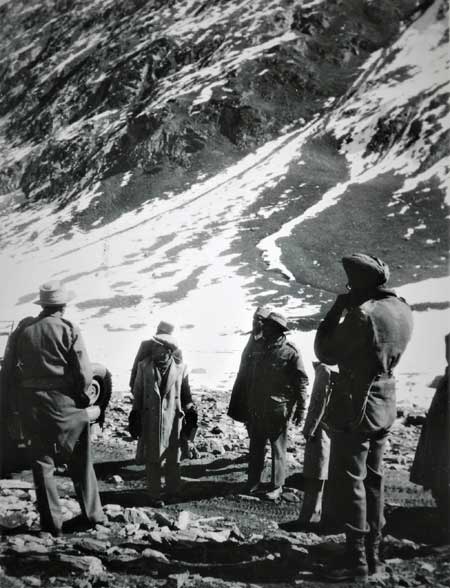
For many months during the summer of 1948, the Indian Army made efforts to dislodge and push back the Pakistanis from the heights around Zoji-La. Almost all the attempts yielded no results. The commanders came to the conclusion that if the enemy was not pushed out of Zoji-La area before the winter set in, it would become impossible to keep them from rolling into the Kashmir valley after the snow melted the next spring. They envisaged that if this did happen then the whole of Ladakh would be cut off from the Kashmir valley and perhaps be lost forever. This was a very scary thought and unacceptable to the country.

The stage was set for a deciding battle. It must be put into perspective that by then the road from Kargil to Dras and onwards to the Zoji-La top – known as the Gumri basin – was under the effective control of the Pakistani forces. In May 1948 the first organised force of the Indian army, the Patiala regiment, was ordered to go to Sonamarg, Baltal and Zoji-La. This regiment was later to be the most highly decorated as they took part in several important battles. In mid-May one such battle pushed the enemy from Gumri towards Dras. This established two objectives – the effective control of the path on Zoji-La and re-establishing the lines of communication from Srinagar to Sonamarg and onwards to Dras via Zoji-La. In June several attacks by the enemy forces were repulsed but they gained ground by reaching the top of the hills around and thereby gaining commanding positions overlooking the complete pass. They soon started beefing up their positions with heavy artillery and also to outflank the Indian positions. Sheer numbers were against Indians but they held positions very bravely and against all odds.

Between June and July major attacks from the enemy established the fact that with such intensity and use of heavy artillery, it was indeed the enemy regulars who were fighting and not “raiders”. Gen Thimaya who was in charge of the entire Valley approved of the organised withdrawal of the forces from Machoi and Gumri to Zoji-La. While it was a tactical move, it meant giving up some very strategic locations in the surrounding hilltops. In the meanwhile traffic on the Srinagar to Sonamarg was restored in July. Plans were afoot to regain control of Dras and Kargil as well as Skardu.

An aborted attempt to find a second route via the Muskoh valley forced the top Indian army brass to have a rethink and make new plans to go through Zoji-La, Gumri and Dras to Kargil. Yet another attempt to go for a three-pronged attack too did not yield results, and with heavy losses the Indians had to retreat. The consequence of the Indian forces not making much headway was actually felt on the Ladakh area, as with a (now) large force, stocking up of rations and ammunition was necessary with winter approaching. The Manali route was decidedly more difficult and prone to closure due to early snow. In September ’48 at a high level meeting under Gen Cariappa it was decided to use heavy tank artillery to push through. That was easier said than done, as the small bridges en route from Jammu area to Sonamarg were a big problem for such heavy equipment. Not only that, there was practically no road beyond Baltal (at the base of Zoji-La) – it was at best a jeepable road and getting heavy tanks to go up the steep tracks would be nearly impossible without being  undetected. On two to three occasions I had observed Gen Thimaya toying with this idea and wondering aloud as to how it could be done. I recall that sometime in the end of September Sheikh Abdullah had visited Gurez along with Gen Thimaya and while driving back (I was in the same vehicle) it was disclosed that the proposal to use tanks at Zoji-La was being favourably considered by the military HD in Delhi.

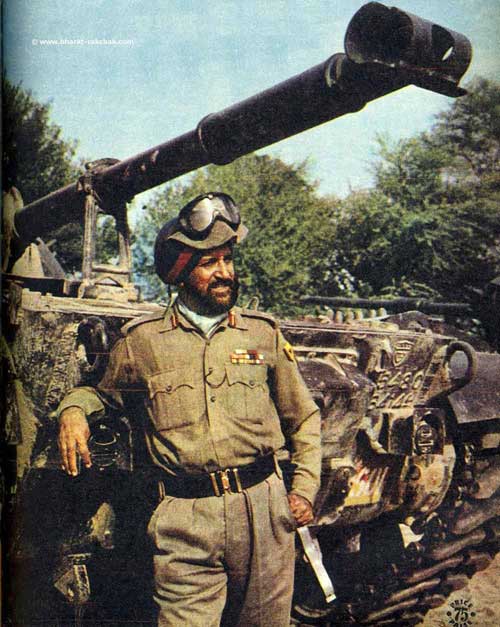
In this background, certain important incidents take on their own significance. First and foremost was how to get the tanks from the plains into the mountains and up to Zoji-La, without disclosing the surprise part of it. Second was how to get the tanks up from Baltal (at the foot of Zoji-La) to the top of the pass (because there was no road beyond Baltal) and the mountainside was unstable and steep. Third was the condition of the ground on both sides of the pass, which had never been tested for heavy weights and no one knew whether the tanks would be able to move on or get bogged down. Having got the tanks dismantled in the Jammu plains, they were transported only during the nights to Baltal and reassembled at the other end. The surprise was kept. Gen. Thimaya devised that an armoured carrier was given heavy plating to bring it to the level of the weight of the Stuart tank which was to be put as the vanguard vehicle so if it sinks into the marshy ground, real tanks would not be lost.

It was in the last week of September that orders were given to 7th Cavalry to move from Akhnoor to Srinagar. Speed and secrecy was of paramount importance. The next challenge was to find a way to make the jeep path drivable for these heavy tanks. Anyone who has been to Zoji-La knows that though it is one of the lowest passes in the Himalayas at 11572 ft., it receives the highest amount of snowfall. I have personally driven through walls of about 93 ft of snow here. Usually the snow starts by the beginning of October, and under extreme cold conditions this is one of the most inhospitable areas.

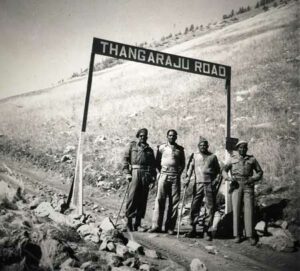
The question of the road between Baltal and Zoji-La continued to be a problem till an officer of the Engineers came forward to complete the task within the timeframe. Eight kilometers had to be cut, widened and made fit for movement of tanks. So the work was started in the middle of September, and the additional labor force was available only a month later.  Due to the enemy being able to watch everything from the heights, work could be undertaken only in the dark. It took more than 30 days to make a road of 9-mile length with a comfortable gradient, which could take the tanks with tracks. The task was accomplished by good coordination under the able and inspiring leadership of Major M.A. Thangaraju. Appropriately, this road was named after him and continues to be known as such. Now only traces of the original road are left.  On this road, ultimately eleven Stuart tanks of the 7th Cavalry went up to Zoji-La and beyond to Gumri Basin. The tank drivers were brave, courageous soldiers and the commanders were able to provide leadership, inspiration and good coordination, teamwork and total commitment, which resulted in the complete success of the venture, and created history.

With everything in place for the final assault, Gen Thimaya and senior officers reached Baltal in the third week of October to oversee the operations. At Baltal there was a two-room forest hut which became the headquarters of Gen Thimaya for the Zoji-La operation. The hut had been used in 1916 by Pandit Nehru and his wife Kamala for their honeymoon. Gen Thimaya was able to retrieve the tourist register with Nehru’s comments and signatures. Thereafter, there has been no trace of the register.

One of the two rooms was used by Gen Thimaya; the other room was kept for visiting commanders.  For the crucial days of the tank breakthrough, three war correspondents were allowed to stay there.  Apart from me, were K.L. Sharma of AIR and Wilfred Lazrus of PTI (API). Gen Thimaya had a Second World War vintage Helicrafter Radio Receiving Set and was fond of surfing. On the night of 1st November, he picked up the local enemy commander of Zoji-La reporting to the Pakistani Brigade Commander that Indians had brought tanks and dislodged them from heights. The Pakistani Brigadier disbelievingly told him that it was impossible, these must be camouflaged jeeps. The General immediately decided that in future briefings and signals, they would use only this phrase for tanks and this façade would be kept up till the end of the operations. The war correspondents were also told to avoid use of words like tanks and armor.  In the meantime, the first-day dispatches had gone across and some were published in London newspapers. We were informed later that the Indian High Commission in London had asked the Defence Ministry in Delhi to restrain Indian war correspondents from reporting “cock-and-bull stories”. The world did not seem to believe that the Indian Army could operate tanks at those heights and under those conditions! We continued to use “camouflaged jeeps” for tanks till the liberation of Kargil on 24th November: when the whole story was published and it established the facts for all time.

Unfortunately, the weather turned very poor with snow and rain. Some saw this as a silver lining as it gave time to revise and go over plans in a much more detailed way. Some of the earlier attempts were wasted due to hasty operations without proper planning, and more importantly adjustment of troops to the harsh weather and height. Finally, on November 1, the orders were given to start the ascent to the main pass from Baltal. Eleven tanks were used for the first time ever on such difficult terrain, so much so that in the final stretch they were winched up. Led admirably by a young Capt Jamwal, the tanks finally reached the flatter grounds of the pass and Gumri Basin. The guns opened up and with the element of surprise and superior firepower in the favor of the 7th Cavalry, by mid-afternoon, the enemy had abandoned their posts. The tanks fired and completely destroyed the foxholes made by the enemy. Although the tanks were able to break through Zoji-La in one day (November 1) they got held up in the next week at the two other places, Machoi and Malayan.

Finally, our troops were held up below the Batkundi Ridge because of the enemy having taken strong positions overlooking the valley below. We were stuck there for almost one week. Surprise attacks around Anant Ridge and Brown Hill were mounted by Indian troops. Senior Generals of Indian forces spent the final night with the troops under open skies, which boosted the troops’ courage and camaraderie. Then, on November 14 the tanks and the troops were able to push through to Drass (reportedly the second coldest inhabited place in the world). Next day was Guru Nanak Dev’s birth anniversary and as the Indian troops were led by soldiers of the 1st Rajinder Infantry of Patiala, the Sikh troops celebrated it in a big way. A day later the GOC arrived along with the press, and celebrations took place.  That night, Gen Thimaya was fiddling with his radio set and he picked up a conversation between a Pakistani Commander and one “Major Ishaq” – perhaps a code name. Ishaq reported that he had come into Drass the previous night, enjoyed celebrations with the Sikh troops, visited his hideout, collected all his papers and documents and returned safely to Mushko valley, under cover of darkness. Gen Thimaya highly appreciated this daredevil feat of the Pakistani officer.

One breakthrough after another eventually led to the liberation of Kargil, and the final linkup with Leh garrison happened. In the Nubra valley too, the infiltrators were pushed back. It is pertinent to point out that without the decisive and dramatic battle of Zoji-La, the map of Kashmir would be without Kargil, most of Ladakh, and who knows perhaps the Valley itself. November 1948 must be remembered as the month when India reclaimed a lot of lost ground and will surely be known for the Battle of Zoji-La amongst many other important battles.

The tank breakthrough of November 1948 in Kashmir was an epoch-making event and opened a new chapter in the military history of the world. Never before had armoured vehicles like tanks, armoured cars etc. operated at such heights and in such trying climatic conditions. The tank manufacturers had never envisaged that armour would be used at those heights under those conditions. They were conceived and manufactured for operation on mostly level ground and the plains.

(A few weeks earlier the French photographer Henri Cartier Bresson, who had become a good friend, had given me his last color film before leaving since I was the only photojournalist around. I had never used color film before and was miserly in using it. After exposure, the film had to be sent to Paris for processing and came back to me after a couple of weeks. However, the first shots on Duafaycolor were taken by me at Gumri Basin of the first tanks that got across Zoji-La.)

On one of my trips from Srinagar to Zoji-La in June 1948, I was waiting at the TCP (Traffic Control Point) at Nilgrad little beyond Sonamarg when I saw a Balti porter carrying an injured soldier in a homespun blanket. On inquiry, I learned that this was the second solider that this porter Mohammad Ismail had brought down in seriously injured condition from an army piquet high up on the cliffside. I was told that due to enemy firing, soldiers in our piquet had been wounded and they were in no condition to come down on their own. Only a daredevil volunteer from down below could go up and help to bring the injured down because the entire cliff face was under enemy observation and hence under fire. I instantly sat down and got all the details from him and got a photograph. This is the only photograph available anywhere of this daredevil porter. When the Ismail story was published it received notice in the right quarters and his name was recommended for being awarded the Maha Vir Chaka. It is interesting to note that this perhaps is the only instance of a civilian being awarded a military medal of this level. Later he was taken prisoner by the enemy on September 13 in Chabutra area. He, however, escaped from their custody and was able to join the celebrations on November 15 for the liberation of Drass. Ismail was forgotten and lived a quiet life in his village for many years to come. In the early nineties, I learned that Pakistani armed militants had shot him dead. It’s a pity that we are not even able to take care of our well-known heroes.
The parleys at the United Nations finally brought about a ceasefire on January 1, 1949, and the actual ground position was demarcated as the ceasefire line and later converted to Line of Control. It is well known that India’s posturing amongst the Western governments and at the UN Security Council left much to be desired whereas Pakistan made a very forceful presentation and courted these governments. It was clear to the Indian government that the powers-to-be of the Western world were against the Indian position and should have continued to engage with them while the military commanders cleared the occupied Kashmir, Skardu, Gilgit and the other Northern areas. There was a view within the military establishment at that time that there was a deliberate lack of information between the Indian government and the military leadership on this. The top military brass was surprised that India had accepted the ceasefire effective January 1, 1949. I am sure that had the military commanders known of what was going on, there would have been a totally different result and the actual ceasefire line would be much more in favor of India. In fact, I had several conversations to that effect with Gen Thimaya as I was part of a small group which took the UN observers to the ceasefire line along with Gen Thimaya (see photo with them).

As we are aware, this issue has not been resolved till date and is the main bone of contention whenever the “Kashmir problem” is debated between the two countries. That is why even today India is not willing to accept the Line of Control as the internal border.

Tacit complicity of the British forces in aiding the Pakistan cause is also well known. Gen Gracey (who was the Commander in Chief of the Pakistani forces) did not hide this and in fact, there are instances when the British Indian establishment acted in concert with him and ensured that the Uri to Nowshera line was not breached by the Indian military. Why else would there be a total reversal of orders when the Indians were in hot pursuit to recapture Domel and Muzaffarabad? Had that happened, the Indian Army would have driven out the Pakistanis from the Poonch and Nowshera area as they would have been outflanked. I am told that only a few senior British Indian officers took this decision and the Indian defense establishment was not aware of it. Sardar Patel was furious about this blatant bias towards Pakistan and insisted that Field Marshal Auchinleck be relieved of command and control to be given to the Indians. Many years later when records were declassified it was found that the British Indian officers and the British government, through its High Commissioner, had totally different plans – basically to limit the Indian forces’ march to regain ground.


Polar Express

7

A trip to the coldest part of the globe ended in a heartwarming experience. By Urvi Piramal

Just five hundred miles below the Arctic, even the air is rarefied. I take deep breaths to steady myself as I look around – not a house, not a bird, not a tree in sight. The air is shallow but my heart is full.

But I am getting ahead of myself. Let me start at the beginning…


It had always been a dream of mine to see polar bears and the Northern Lights or Aurora Borealis. And when the opportunity presented itself, I jumped at the chance. We set off in September, journeying first to London, and then to Toronto. From Toronto, we took a roughly one-and-a-half-hour flight to Winnipeg, where we stayed the night. The next morning, we took a two-hour flight to isolated, icy Churchill.

Aside from its unofficial self-proclamation of being the polar bear capital of the world, it also houses a polar bear jail. Yes! You read that right. Because of the annual surge of polar bears Churchill experiences during their annual migration route north up Hudson Bay, there is actually a jail for polar bears for potential or actual ‘offenders’. Here, the polar bears can be imprisoned by authorities if they seem dangerous for ‘crimes’ such as attacking and mauling until they are rehabilitated later in the safety of their natural environment.

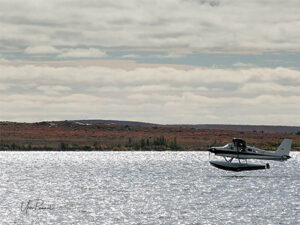
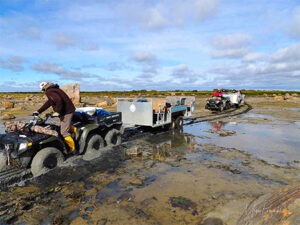
Final stop after Churchill, on a total 30-hour journey from Mumbai, we clambered on a seaplane to Seal River Heritage Lodge. The plane landed in the middle of a water body where we were welcomed by the proprietors of the inn. Here, we loaded our luggage onto a heavy-duty, industrial-strength tractor, and began our ride to the final destination.

And this is where I begin my story. Wrapped in a coat that could withstand minus 20 degrees centigrade; feeling the freezing cold air around me; taking in the barren frigid terrain; taking in one deep breath after another.

A Hidden Gem  

Seal River Heritage Lodge, as its name suggests, reposes by the mouth of the Seal River and is home to bears, birds, and whales. The lodge is run by a local family and runs three safaris per year: a Canadian signature experience through July and August, an Arctic safari in September, and a polar bear safari in October and November.

The eco-friendly lodge, aptly reviewed on Tripadvisor as a “hidden gem” is more than 400 miles away from the nearest town. Supplies have to be perfectly ordered so that nothing runs out and that nothing is wasted. Groceries, essentials, medicines and other items are flown in once a week. As a vegetarian on the trip, I was just a tad anxious until I was told the lodge had a surplus of potatoes on which I could feast in the days to come.

But for all its seclusion, the lodge was very comfortable, with wooden beams and warm fires; and in my small room, I felt very cheerful and cozy.

Icy Adventure   

Bright and early, we rose the next morning, eager to leave the coziness of the lodge and rush headlong into our Arctic

experience. The frigid air hit us with a blast, and we huddled together as much as we could in a single file: a guard at the beginning and end flanking our procession. They each carried a rifle and some stones. During combats and to deter rivals, polar bears click their teeth, with the most resounding click winning out. The stones carried by our guides were to replicate this clicking sound in the event of encounters with unfriendly and feisty bears – and obviously to use the rifles as a very last resort.

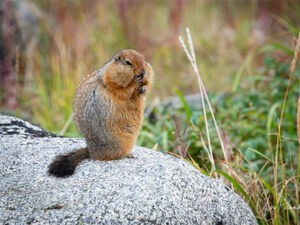
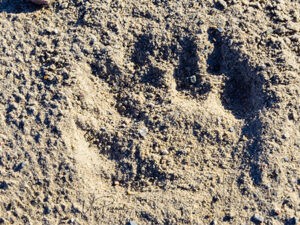
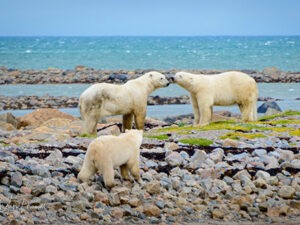
The very first thing we saw was a sic squirrel, which lives in the ground, and was no doubt foraging for the long winter months ahead. Up next we saw what we had all been waiting for: a giant pug print of the polar bear.


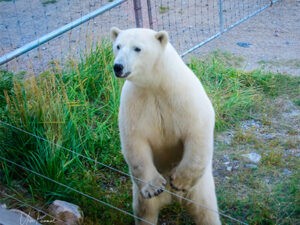
Excitement flooded my veins and I felt my heart beat faster, from thrill, from fear, as we looked around in anticipation for the polar bear. We were soon rewarded: there he was – the ‘resident’ polar, whom we will call Hugo. A giant among the sparse terrain, white and cool, staring at us, his body languid, his eyes alert. After a

few cool seconds, and a final desultory sniff, he ambled off. I forgot to be scared and could only take in his big beauty and marvel how despite his size he could move so fluidly and gracefully.

Arctic Safari

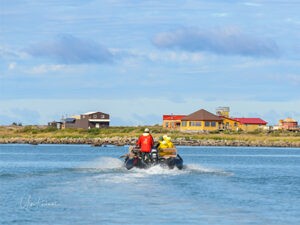
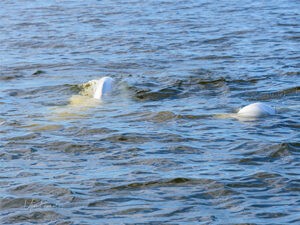
On our second day, we strapped on water galoshes – thick waterproof rubber shoes – and piled into a zodiac, an inflatable boat, as we made our way into Hudson Bay , to spot the elusive beluga whale The air above the lake was even icier and as we drifted along, I took in the barren beauty of the shore, dotted with black spruce.


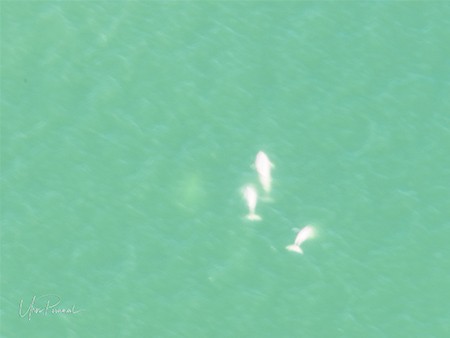
Especially on the water, the air was frozen and misty, but we were rewarded when our guides saw a school of belugas. About 13-feet long, small by whale standards, the whitish whale is aptly named beluga, derived from the Russian word belukha for white. Our guides then dropped a device into the water which detected underwater sonar and allowed us to eavesdrop on the whales as they “spoke” to each other.

As we mounted ashore, our adventures were not done. On our way back to the lodge we saw a scuffle between two polar bears: our fellow resident and an unwelcome intruder. Hugo threateningly warded off the interloper and we arrived, exhilarated but cold, at the end of the day.

Later that evening while we ate dinner – incidentally a meal that involved aloo bhaji, we noticed we had a wayside guest: Hugo had propped himself up on his hind legs and was peering into the dining room as if to hopefully invite himself over for dinner.

Sky Light

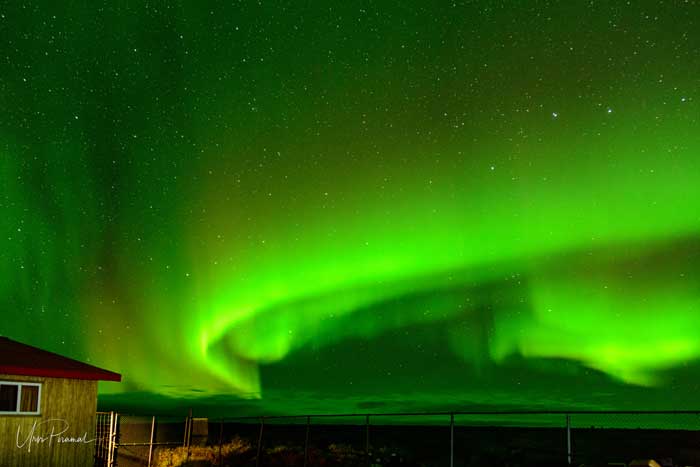
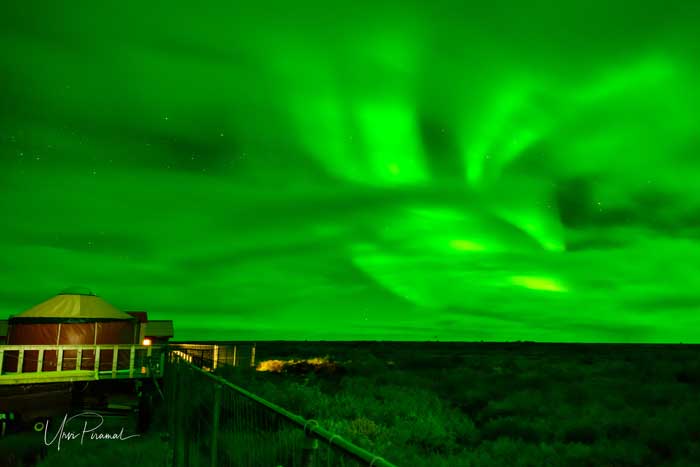
On that final night, I looked into the chilly sky, hoping to see the Aurora Borealis. I knew that the Northern Lights – caused when electrically charged particles released by the sun enter the earth’s atmosphere and collide with nitrogen and oxygen – are earth’s own natural and stupendous display of color. Yet, nothing could have prepared me for the flashes of brilliant colour – green, glowing neon, shafts of red – that lit up and danced across the northern sky as we stared on, awe-struck.

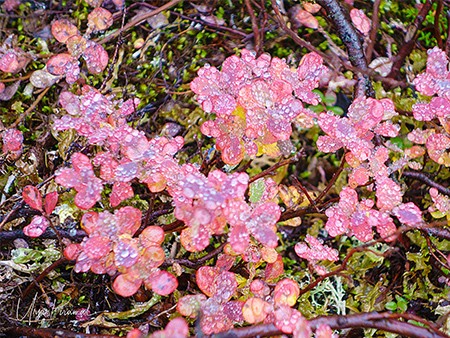
The next day, we traveled even further up north via seaplane to the Schmok Lake Caribou Camp, to catch the caribou migration. The camp, only reachable by air, was home to wolves, wolverines and arctic foxes. The entire terrain, in this last fall month, was covered with dwarf shrubs and arctic fauna in a riot of colors – yellows, mustards, rust orange, maroons, reds, pale and dark greens. Here I shared a room with a friend but was a bit disconcerted when I realized our room had no door. The owners of the camp kindly obliged us by providing a makeshift door: a shower curtain – to give us some privacy

.

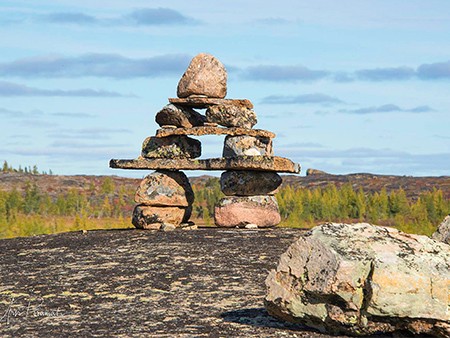
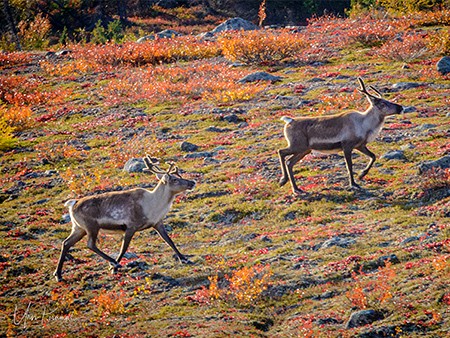
Around the camp, the area was spotted with inukshuks – mini stone markers that had historically been used to guide travelers and native Inuits. Unfortunately, while we missed the massive passage of the herd, we did manage to see a few caribou, with their lithe, muscular bodies and fierce antlers.

It has been a while since that trip.


When I look back, I remember the bears the whales, the way we walked 8-10 kilometres per day, the way we picked berries and ate them. I remember how we gathered mushrooms, sorted and cooked the non-poisonous ones, and how good they tasted. Most of all, I remember my excitement at seeing that first polar bear, who will always affectionately be ingrained in my memory as Hugo; and how, when looking at that magnificent coloured sky, more fabulous than any painting I have ever seen, how full my heart had been.

The 10 Commandments of Grand-parenting

5
For children, Spending time with their grandparents is a source of joy. Here’s how to manage them – and yourself. By Senor Dey

There was a time when every summer holiday you went home to your Nana-Nani’s (maternal grandparents’) house where your mother was the star and you were the superstar. Everybody pampered you, spoilt you, and made plans to suit your requirements. Depending upon your age you could be taught religion, fly as many kites as you want, cycle around all morning. Many relatives came to meet you, gave you gifts of money, you got invited to their homes, everyone asked what you wanted to eat and at the end of the trip, grandfather gave you a hundred-rupee note that was immediately confiscated by your mother and at every argument, you wanted your note back. Grandma shed tears at your departure, there was something warm in the scent of her embrace, and that memory lingered on for a long time even after you grew up.

The relationship between a grandchild and grandparent is a special one. Time spent with Nana-Nani/Dada-Dadi (paternal grandparents) holds such fond memories for most of us. The exchange of silly words or expressions, an affectionate clever nickname given by the grandparent, playing peek-a-boo, being their favorite playmate, the simplest of pleasures build a strong, everlasting and sacred bond. While grandparents act as an authority figure and provide unconditional love, they also get to spoil their grandchildren in a way parents simply can’t. But beyond that, grandparents also wield incredible influence.

Links through stories

Children love ‘long ago’ and ‘faraway’ stories. The history of the family is passed on in the telling of the stories. The richest families are those in which stories have been remembered, treasured, and incorporated into the spirit of the family. They are the living bridge between the past and the future of a family. When grandchildren hear these stories they learn who they are and from where they came; a landscape of generations is painted in front of them. Maintaining and passing on the family stories is a precious gift that grandparents can give to their grandchildren.

Haresh, 72, shares: “Every time my grandson visits I have to be prepared with a knick-knack surprise for him. The day is planned around him as he likes to go to the park and play with the animals around, which fascinate him. He loves telling ghosts stories and at that moment I become a child and amuse him by acting frightened. His presence provides a sense of fulfillment, and life feels complete. There is nothing more I could have asked for than the joy of spending quality time with my grandson.”

Asal se zyaada sood payaara hota hai” – the interest amount is dearer than the principal amount, he adds.

Says Subhash, 65: “I do not interfere with the upbringing of the grandchildren. I do not disagree with the parents in front of their children. My wife and I plan trips to the zoo at least two to three times a year with a food basket and a sheet to spread on the lawn. We walk around the zoo looking at the familiar animals, come back home read about the animal we saw and check out videos on National Geographic channel on YouTube. I have done so on giraffes, tigers, lions and have planned to take my grandchild to the Gir National Park. Although the trip is four months away there is a lot of excitement as he has already learned how to use the phone to take photographs. I plan to get him trekking shoes and go on hikes with him.”

Support in troubled times

Yet another grandparent, Seema, is a ‘Nani’ whose two teenage children are unable to cope with the hostility between their parents. The marriage has broken up and the economics of the situation does not allow for a divorce. Rather than grieve over this she is reassuring her grandchildren that they are not the cause of their parents’ fights and that she is a safe person for the children to talk to, to hear their anguish about why their parents couldn’t learn to get along with each other. She does this without laying blame on either parent. She is the saving grace in her grandchildren’s lives during this period of tension.

No matter how carefully parents think that they have disguised such feelings, children nevertheless pick up the vibes and suffer from them. Here, grandparents can provide the steadying factor of a warm relationship which the child feels will not disappear. At a time like this, it reassures the youngsters that grandma’s world is a safe place they can come to and she will not desert them. She is on their side. Being a grandparent, Seema has learnt some coping skills that she passes on to her grandchildren, and spends more time with them. She believes time is the best gift a grandchild can get.

Points to Ponder

After chatting with grandparents across the spectrum of society, the following advisory emerged:

  1. A little distance is good for the relationship. It’s all right if your son and his wife stay separately from you. They may have various reasons – jobs, economics, and independence.
  2. Treat your son’s wife as his wife, not as your daughter. Maybe treat her like a friend. Your son would always be your junior, but if you think that his wife is of the same rank and if you ever scold her, she will remember it for life. In real life, only her own parents will be viewed as qualified to scold or correct her.
  3. Whatever habits or characteristics your son’s wife has, it’s not your problem, it is your son’s problem.
  4. Even if you are living together make each other’s territories very clear. Who is going to cook the food, do the laundry or babysit the children, unless of course there is a special request made by your son? If you feel that you are capable and are happy to babysit don’t expect anything in return.
  5. Pretend to be blind and deaf when your son and his wife are quarreling. It’s normal that young couples quarrel. Also, they do not like their parents to be involved in a dispute between husband and wife. Most importantly, you shouldn’t worry about your son’s family problems – let them settle it between themselves.
  6. Absolutely do not interfere or volunteer opinions on matters that concern your grandchildren. Your grandchildren belong to your son and his wife; whichever way they want to raise their children it is up to them. The credit or the blame would be upon them.
  7. Plan your own retirement. Do not rely on your children to take care of your retirement. You have already walked through most of your journey in life; this is the time to have fun.
  8. It’s in your own interest that you enjoy your retirement years. Utilize the time and your money and put them to the best possible use you can.
  9. Grandchildren do not belong to your family – they are their parents’ most precious gift.
  10. Grandchildren give you true and pure love, and in the saddest of moments can bring a smile to your face. Cherish their warmth and tight little hugs. A child is a child for just a moment; hold on to that moment, you may never see it again.

The best part of being a grandparent is giving the gift of your time. For a child there is nothing more joyful than spending the day with their grandparents, exploring new things. The whole experience becomes a part of making memories that will last a lifetime, not only for the grandparents but also for the grandchildren. Warm and enthusiastic grandparents are supportive, devoted to their grandchildren, and can often be indispensable.

Where there is a Will…

1
…there is no ambiguity. Sonavi Kher Desai explains why everyone must get a Testamentary Will made

The English philosopher, John Locke, wrote: “Every man has a property in his own person. This nobody has a right to, but himself. The labour of his body, and the work of his hands, we may say, are properly his.” Although he goes on to add a moral caveat, we can interpret this as the right of every man, through his own effort, to acquire property, which belongs entirely and only to him. So how does a person’s property devolve when he passes on? The answer to that depends on whether he has had the foresight to leave a “Testamentary Will”— in other words, whether he has died testate or intestate.

It is advisable to make a Will to provide for the distribution of assets after one’s death. A Will is a legal document made by a person in his/her lifetime, containing directions about how they want their property to be distributed and/or managed after their death. Interestingly, the practice of making Wills can be traced to the Greeks. According to Plutarch, property used to be inherited solely by a person’s family until Solon made the law that allowed a person to leave his property to someone outside the family, subject to some conditions.

The basic requirement of a valid Will is that the person making it should have been of sound mind and not a minor when the Will was made, and it must be made of his/her own free will. There is no prescribed form for a Will although it usually follows a certain pattern to ensure that it is sound enough to prevent it from being contested. In India, if a person dies testate, succession to his/her property would be governed by the Will under the Indian Succession Act, 1925, irrespective of his/her religion (other than Muslims who can give only a part of their estate under a Will).

How to make a valid Will
  1. The testator must declare that he/she is of sound mind and not a minor.
  2. The testator should revoke all previous Wills if they exist and declare this to be their last and final Will.
  3. The testator should appoint Executors of the Will, and in case the Will creates a Trust, then Trustees.
  4. The Will should contain a description of the assets owned by the testator, including immoveable property, bank accounts, cash, investments, jewellery, other assets to be bequeathed, intellectual property, and in today’s times also email and other digital accounts and passwords.
  5. The Will should name beneficiaries. If there are several beneficiaries then a detailed list or share of assets bequeathed to each beneficiary should be clearly mentioned, including the beneficiary/ies of the residue assets which are not specifically listed. If any beneficiary is a minor, or not of sound mind, then a custodian for such assets should be named.
  6. The Will should be dated and signed in the presence of two witnesses.
  7. It should contain the names, addresses and signatures of the witnesses.

It must be mentioned here that there are different rules that apply for HUF (Hindu Undivided Family) property. A valid Will may be amended by a Codicil, a legal document deemed to be part of such Will. It must follow the same rules as a valid Will.

Intestate Death

Not everyone makes a Will and therefore when a person dies intestate, inheritance laws apply as follows:

  1. In the case of Hindus, Sikhs, Buddhists, and Jains, the applicable law is the Hindu Succession Act, 1956.
  2. In the case of Muslims, inheritance is governed by Sharia law.

In the case of Christians, Parsis, and interfaith marriages under the Special Marriage Act, 1954, the Indian Succession Act, 1925, would apply.